Makes Me Wanna Holler…….

The journey of being a Black Man is filled with ups and downs, joys and pains, sorrows and triumphs. While always a roller coaster of emotions, I would not trade it for the world. Being a Black Man also gives you a lens and perception that has been framed by your daily reality and that reality and experience of those who look like you. While no two experiences are the same, when it comes to stories of racism, social justice, bias and the Black Man’s Journey, my brothers and I have a lot of moments when we say, “That happened to you too?” When we ask the question, most times it is not a question but instead a statement. A statement that is all to familiar and connected with consistent mistreatment and misperceptions of who we are. The bias against us is real and sometimes it is NOT unconscious.

As I journey through the life of being a Black Man, sometimes a situation happens that lets me know that the views of the world towards me and my reality of living in this world has forever changed me. While driving home tonight, I was fast approached by a police car coming up on my right hand side while my daughter and I were on the highway. At first I thought ok where is my wallet? Is it in my back pocket? Do I need to reach for it? Who should I call if I get stopped to identity my whereabouts. What will happen to my daughter? How will she be impacted by this stop? Will she be safe? All of this and more raced through my head. The police car did not stop. Instead, it raced by and approached quickly two other police cars that were on the side of the road with lights flashing. Those police cars were directly behind a black SUV. I saw the driver of the SUV with his hands out of the window with what looked like keys in his hands. The police appeared to be on the side of their respective vehicles with their guns drawn. This I am not sure of, but it is what it looked like to me.

As I drove by, the first things that came to my mind were, Was that another Black Man in the SUV? Is he OK? Will he be safe? My second thoughts were, Should I circle back on the highway? Should I circle back and pull up behind the cop cars and use my camera phone? Will my daughter be safe? Will I be safe. Am I overacting? I also thought I know some good cops. Some cops ate my good friends. These are probably good cops. So many statements and questions running through my head. Made Me Wanna Holler.

As I kept driving home, my 7 year old asked, “Daddy, what would happen if we got stopped?” My mouth got dry. I took a couple of deep breaths and then asked her, “What do you think will happen?” She said she did not know. I knew I could not leave her with that thought, so I said we would be OK. I told her the police would just help us out and make sure we are safe. They would position their cars so no one would hurt us from highway traffic. I said we would be OK. This is is the substance of what I hoped for and the evidence of what could be seen if we were stopped. I have faith. However, my faith is tempered by my Black Man Experience, My Black Man Reality, My Journey with Philando Castile and his family while serving under Governor Dayton and the fear and insecurity and doubt when you see a different experience for you and those that look like you in this country. Made Wanna Holler.

Tonight Made Me Wanna Holler. I don’t know what happened to the driver of the vehicle. I don’t know the probable cause the officers had to stop the vehicle. I don’t know the demeanor, professionalism or bias of the officers. I don’t know what animus was, or could be exhibited by the passenger in the car. I don’t know anything because I kept driving. However, I do know that my experience and the experiences of other Black Me. who look like me Makes Me Wanna Holler because every time this happens, I have to process my angst, anger and fear and my daughter has to say to herself, “What will happen to us Daddy?”

Makes Me Wanna Holler…………

The Real Meaning of Pride

As a kid, my mom use to always talk to me about the real meaning of Christmas. She told me that the visuals that I see of Christmas which include Santa, Rudolph, Frosty, Elves, etc did not reflect the true meaning of the holiday. She indicated that the holiday was more about sacrifice, giving, love and acts of kindness.

As we wind down Pride Month, I am reminded of my mom’s words of wisdom. Pride Month is not about the visuals of parades, floats, rainbow colored paraphernalia and speeches. Instead, the true meaning of Pride is reflected in actions of courage, sacrifice and commitment towards equity for members of the LGBTQ community.

On June 23, 2019, many members of the executive team at Childrens Minnesota participated in the Pride Parade. The visuals were great. Our CEO played trombone in a LGBTQ band that marched in the parade, my daughter and I handed out lip balm and other Children’s Minnesota branded items along the route and many Children’s employees and their families walked, waved and shook hands with the massive crowd. The visuals were amazing.

On July 2, 2019, the real meaning of Pride was revealed. For the last several months, I noticed the single stall restrooms in the executive offices at Children’s Minnesota in Minneapolis were designated for Men and Women on the respective restrooms. I asked a few people at the time why the restrooms are not gender neutral since they are single stall and serve mainly people in the executive suite. I asked would it be ok if we changed the signs to reflect gender neutral restrooms. I also spoke with the Executive Sponsor of our Pride Employee Resource Group and asked if she would support the change. She emphatically said yes. I was pleased. I then thought I should probably start the process of meetings I thought were necessary to make this change. I thought there had to be a significant and probably lengthy process to make this happen. This is where I got surprised. There were no meetings called, there were no outside experts consulted, there was no data reviewed to prove disparities, instead a decision was made and #EquityActions taken. The temporary sign below (permanent signs ordered) was placed on the display outside of the restrooms. “The restroom may be used by any person regardless of gender identity or expression – Restroom.” The visual of this sign is amazing .

Pride will always be a festive and good time every June. I look forward to attending every year. However, I also look forward to what actions people will take after Pride to assure Equity and Inclusion for the LBGTQ community. #EquityActions!

The Impact of Structural Racism – Think About It and Be About It – #EquityActions

When I first heard the term structural racism, I was confused as to the meaning of these words. I had experienced individual racism and heard the hurtful names and phrases we as Black people, as well as others, have been consistently called. I have also viewed many videos and pictures of scenes depicting slavery, lynchings, fire hoses used against human beings, lunch counter attacks on college students, and kkk rallies with vile and bigoted language. These actions plus the position of power of the people who exhibited these behaviors = Racism. I thought these actions were deflating for communities who suffered from them. Little did I know that Structural Racism has more of an impact than these heinous and disgusting acts.

Structural Racism is the creation and implementation of public policies, institutional practices, and negative cultural narratives that perpetuate racial inequities and constrains mobility, flexibility and attainment for Black, Latino, Asian and Native communities. Structural Racism is designed to create structural barriers that create Race based disparities in healthcare, education, economic development, employment, family income and wealth and housing. (Urban Institute – Structural Racism in America)

The impact of Structural Racism is reflected in the clear disparities that exist in Minnesota and continue to cast a dark shadow over the state’s economy and well being outcomes for Minnesotans. While we seek to create a more equitable, diverse and inclusive state, we must acknowledge that the impact of Structural Racism is not only realized in the policies that led to the Black Codes, Jim Crow and Racially Restrictive Housing Covenants, it is also prevalent in current policies that guide hiring practices, philanthropy models of investment, board of directors selection processes and leadership development and succession planning in nonprofit and for profit institutions. Just to name a few. If Equity, Diversity and Inclusion are to be visualized, implemented, and practiced, we must examine how structural racism is exhibited and how we must change our system behaviors to impact this work.

Think About and Be About It – #EquityActions

Over the next few blog posts, I will address some of the systematic barriers created by structural racism. These systemic barriers must be addressed through sustainable equity actions and designed and communicated through collaborative partnerships that build trust in communities impacted daily by these equity actions.

Equity actions will not require another disparity study. Equity actions will not require a new review of disaggregated racial data. Equity actions will not require another leadership cohort group to study racial inequity, read another book on racial justice, nor have a conversation on race. Equity actions will not lament the educational, health, employment and economic disparities in Minnesota, nor will Equity actions wait for the next national ranking to tell us (what what we already know) how bad Minnesota ranks for Black, Asian, Latino and Native people.

#EquityActions will provide recommended actions to:

Build Community Trust and Positive Relationships with communities of color, LGBTQ communities, disability communities, veteran communities and other diverse communities

Remove HR Policy and Procedure Barriers to Recruitment and Retention

Increase Equitable Access to Business Opportunities

Increase awareness and leadership competencies for inclusion and equity

“As I grow older I pay less attention to what [people] say. I just watch what they do.”

Andrew Carnegie

#EquityActions – the time is right to start doing something and creating sustainable actions to make Minnesota great and equitable for all Minnesotans.

James Burroughs

We are who we were raised to be! Systemic and Institutional Racism in 2019 is not a surprise to me.

A few weeks ago I saw a great movie entitled The Best of Enemies starring Taraji P. Henson and Sam Rockwell. The movies was based on a true story. For those of you who have not seen the movie, I will not provide too many details and spoil the plot. I will share that the premise of the movie is about a Klu Klu. Klan leader, a civil rights champion and desegregation in Durham, North Carolina public schools in 1971-72. The story vividly discusses how many white men held open membership in the Klan and also held public office, were business leaders and also influenced public policy.

The story makes clear how racist actions were not only accepted, but endorsed by the political, economic and social systems during this time. True structural racism and the long term impacts of it were showcased in this film. The film has me thinking about this question: Why are we surprised about racist systems, institutions and behavior in 2019, if this is how we were raised? We were raised to be who we are.

During the time period reflected in this movie, I was 4 years old. I was born in Detroit Michigan and my mom was 25 and my Dad was 38 at the time of my birth. My mom was raised by her mom who was born in 1900 in Grantville, Georgia. My dad was raised by a mother born in the late 1800s in Birmingham, Alabama. Both of their mothers taught them through the lenses of what they knew and what they experienced. Living in the south, they were taught about racism, civil rights, lynchings, Jim Crow, Black Pride/Power, the power of faith, etc.

My mom and dad’s character was developed by the experiences of their parents. They became who they were raised to be. As my parents raised me, they imparted knowledge of their experiences as was passed down to them. I learned about the impact and importance of Black history, segregation, discrimination, racism, Black Power, Black Economic Development, Black Political Power and many things about racism in the Deep South and the North. What I learned shaped who I am as a leader and guides how I create teams and manage people from diverse backgrounds and experiences. How I was raised is important and defines in part who I am.

Just like I was 4 in 1971, so were the children of the Klu Klux Klan and White Council members in the movie (true story) Best of Enemies. In Durham, North Carolina, these young people were influenced by their parents and grandparents just as I was influenced by my own. They learned about and were expected to enforce bigotry, white supremacy, discrimination, racism, prejudice, etc. They were also exposed to discriminatory acts, by their relatives, from lunch counter attacks, dog attacks and other vicious acts against Black people, including but not limited to lynchings, beatings and other heinous, yet not prosecuted, crimes. How these kids were raised defines in part who they are.

As I reflect on the fact that I am only 51 years old and the children of the Klan members and bigots in the movie are the same age or younger, I realize why we should not be surprised when we encounter behaviors and systems that exhibit fear and hatred of other races, religions, ethnicities, sexual orientations, etc. We are who we were raised to be. The way we change this dangerous trajectory of acting how we were raised is by doing a few things differently:

Create circles where there are many opposing views and racially different people in the room. We must have those we hate and those who may hate us at the table. It is through learning who we are and who we can be, that we can make a difference in our thoughts and actions.

Acknowledge and address the impact historical and current trauma has on our interactions and behavior. As you have learned through this blog, who we are and how we think is parent/culture/environment driven and is in fact not so historical after all. I am still a fairly young man (my belief) who grew up in an era with others whose parents endorsed and enforced bigotry and violence based on race. How we react from a social emotional standpoint must be addressed before we rush to searching for solutions for biased behavior and racist systems.

Stop being surprised that bigotry, intentional bias, racism and white supremacy still exist. You are who you were raised to be. Let’s stop thinking that lynchings, Jim Crow, and the Klan were so far in our rear view mirror. In fact, we are not even a generation removed from heinous acts conducted solely against people on the basis of race. We are not a post racial society because we have never fully embraced, examined nor changed our traditions, values and behaviors that reinforce racial inequities. Racial disparities are not a surprise. They are the product of a system designed to create and sustain racial disparities. A system based on hatred, bias, prejudice and discrimination cannot produce racial equity.

Action, Action, Action is important. To know is to acknowledge; To understand is to comprehend; To validate is to address trauma; To act is to build upon the learnings and make sure we change behavior to break the cycle of who we were raised to be. I hope each of you see the movie Best of Enemies and realize that we truly have come a long way, but that the way by which we have come is not to far removed from atrocities and despicable learnings that we have not acknowledged, addressed or changed. We must destroy and replace the culture and systems built on racism that produced racist results and created racial disparities. Now we must act with urgency and not be surprised that in 2019 we are experiencing the results of who we were raised to be.

JB

#FadetoBlack

A Seat at the Table – Are You at the Adult Table or the Kid’s Table?

As a kid growing up, I always longed for the day when at Thanksgiving or Christmas Dinner I could sit at the big table. As most of you know, the big table was reserved for adults. For the kids at the little table, we knew the food was hotter and tasted better at the big table. We knew the drinks were more thirst quenching at the big table and the desserts were even sweeter at the big table. We all wanted to be at the big table – the Adult Table – where things were nicer.

The current mantra for equity and inclusion is to have a seat at the table so you can voice your opinions and have a role in decision making and outcomes. While this mantra is great and can yield positive results, it can also lead to the reality that no positive change will occur because you are at the wrong table. Your equity and inclusion invite may be to the kid’s table. When invited to be at the table, I suggest you ask yourself the following questions before you accept the invitation:

1. Am I being invited to the table because of who I am (my character, knowledge and experience) or am I being invited to the table solely because of the group of people I am perceived to represent? Am I seated at what has been designated as the black spot, the gay spot, the disabled person spot or am I allowed to bring more to the table? Will my voice be heard on all decisions or am I only heard when someone thinks it is a Diversity Equity or Inclusion issue?

2. Has my place at the table already been set for me and has the meal already been ordered for me by someone else? Can I have my own plate and make my own decision about what I want to eat? Am I being given only the portions of the meal that someone else wants me to have or can I look at the table and see what I want and like and then DECIDE what to order for me and others. Can I bring other things to the table that are not traditionally there (additional seasoning, hot sauce, herbal blends, non traditional meals)? If I bring new things to the table will other people eat them with me or just force me to eat by myself?

3. Does the table actually serve real food or is it serving plastic fruits and vegetables that they have on display and you can’t really eat. Have you been invited to a table for appearances sake? After the meal is complete are you still just as hungry as you were when you sat down? Is the only thing that is different is that people have the IMPRESSION that you are actually eating? Is there any nutritional value for you or others?

4. Did the table change the name and purpose right after you got the invite? Remember when IHOP (International House of Pancakes) briefly changed its name to IHOB (International House of Burgers). A place known for serving one type of speciality food was now marketing itself as being an expert in making a completely different type of food and expected the world to believe it. Did the table you were invited to change the focus right before you arrived? Is the table still serving the intended purpose or has it been watered down and no longer serves the quality of work or services it was doing before you arrived?

5. After you have finished your meal and the last drink and bite has been taken, is the table still inviting people to it who look like you? Were you the only special person in your group that ever gets invited to the table? Are you the only Black friend, gay friend, disabled friend, Asian friend, Latino friend that ever gets invited to the tables? Does the table now realize that there are many people like you that should have been invited and should be invited in the future? If the table is no longer exclusive, it might mean that accepting the table invite was worth it.

Always ask yourself are you at the Adult Table or at the Kid’s Table?

#FadetoBlack

JB

Minnesota Nice – Is it Really All That Nice?

When we were kids our parents told us to “be nice” and “play nice.” Nice was the same as doing the right thing. No one would complain about someone who was too nice. If you were extremely nice someone might even say “aww you are so sweet and nice.” You might even get recommended to others as the nice guy or nice girl. You were rewarded for being nice.

As a young kid growing up in Detroit, I was also taught another side of nice. I was taught by my dad and grandmother to be leery of adults that are “too nice for no reason.” I was also taught that if an adult was too nice they may want something in return of their niceness. They may have something they are hiding from you. The reason for hiding something could be that they want to pretend like they have your best interest at heart when in fact they don’t. My grandmother concluded my lesson by saying that people being nice for no reason sometimes avoid the truth, avoid confrontation and sometimes are just being nice to get something from you. Being nice was not always a good thing.

Minnesota Nice

When I arrived in Minnesota in 1992, I was presented with Minnesota Nice. People smiled at me. They cheerfully said hello. They invited me to lunch and coffee, but not so much dinner and never their home. They told me they were glad I am working with them and invited me to old Irish bars and taverns for drinks, although I did not drink alcohol and was obviously not Irish. They were Minnesota Nice and proud of it. I knew that some of the nice had to be because I was the only black or brown person in the room, in the company or in the professional community. The Minnesota Nice was specifically directed at me, but was it a good thing to be nice or was it what my grandma warned me about?

Is Minnesota Nice, Not So Nice? Does it depend on your understanding of cultural proficiency or cultural humility. Does it depend on whether you are a person of color, Indigenous person or from an underrepresented group? Is Minnesota Nice having a negative effect on Inclusion and Equity.

Minnesota Nice – Intent vs. Impact

Let me start with this premise. I do not believe Minnesota Nice or those that embrace Minnesota Nice are evil or have an opposition to Inclusion and Equity. Some people who engage in Minnesota Nice believe that it is a great thing for all Minnesotans. They do not have an intent to do harm. However, I do believe that those who adopt Minnesota Nice as their go-to engagement strategy do not take the time to listen to those who receive their Minnesota Niceness and determine the impact of their actions or words.

My grandmother always said actions speak louder than words. You can say all the right things, but your actions demonstrate how you really feel. She always said believe people and how they treat you. When it comes to Minnesota Nice in communities of color, indigenous people, people with disabilities and LGBTQ communities, Minnesota Nice can be seen as a passive aggressive way of dealing with issues. The Niceness avoids confrontation and conflict and still keeps the status quo. A status quo that results in continued disparities and racial inequality. One example of Minnesota Nice is the adoption of Conversations about Race and Equity. These conversations have been described in many ways and had many “experts” deliver the message or facilitate discussion. As my friend St. Paul Mayor Melvin Carter describes this term, expert means someone from out of town. These conversations have great intent to make change, but the Minnesota Nice portion of these conversations lead to only more and more conversations. Never Action and never sustainable changes. The intent is good, but the impact has never had long lasting impact. Conversations are not bad, but they must be accompanied by concrete action steps that sometimes cause pain and discomfort.

The People of Color, LGBTQ, Indigenous People and People with Disabilities Dilemma

It’s is now 2019. By now Minnesota Nice should have led to substantial changes in Minnesota as it relates to Equity. In a state that aggressively practices Minnesota Nice, we should not lead the nation in racial disparities or unequal and inequitable outcomes for other populations. However, we continue to lead the nation in these categories. Can we blame this on Minnesota Nice? Let’s take a look. A good friend recently made a FB post and she said that she would adopt some of these behaviors in her upcoming posts: 1) not make anyone feel uncomfortable or less than; 2) keep her (true) opinions to herself; 3) tiptoe (and not speak directly) about challenging conversations or issues; 4) not ask thought provoking (or controversial) questions: and 5) not ruffle any feathers and remain extremely neutral. Under closer examination of these behaviors my friend summarized very well the problematic nature of Minnesota Nice.

Minnesota Nice may at times avoid activities, conversations or actions that make people feel uncomfortable. This may mean failing to take a stance on discrimination, police brutality, institutional racism, etc. The comfort gained by inaction is in fact a passive aggressive action that causes more discomfort to marginalized communities than being direct. Minnesota Nice also manifest itself around keeping true opinions secret and avoiding challenging conversations or issues. On more than on occasion, I have heard many communities of color and disability communities make this statement, “I wish people would really tell me how they feel about race/disability, because if they did we could address the real issues.” Minnesota Nice does not promote direct expression because it could lead to loud and passionate conversations where people show emotion, pain and other non Minnesotan characteristics. These actions would of course make people feel uncomfortable and incapable of addressing honest solutions. Being afraid to rock the boat has a direct correlation with Minnesota Nice.

Martin Luther King, Jr. said it best, “In the end, we will remember not the words of our enemies, but the silence of our friends.” Minnesota Nice can be a passive aggressive silence that further disconnects communities of color, indigenous communities, disability communities, LGBTQ communities and others. Minnesota Nice can show up in the veil of friendship and leave with a deafening silence on issues of policing, racial disparities, and outright bias and discrimination. Sometimes being Too Nice is just talking about it instead of doing something about it. Sometimes when actions occur pain or raw emotion may need to be seen before a change happens. Sometimes Minnesota Nice gets in the way.

Conclusion

If you are from Minnesota it is ok to be nice. You can use good manners, be courteous and be respectful to everyone. This type of behavior is encouraged. It is also encouraged to acknowledge when Minnesota Nice becomes Minnesota Ice and passively and aggressively excludes and marginalizes populations of people who don’t think or act like Minnesotans. Minnesota Nice at times must be replaced by authentic conversations and actions that push, challenge, cause angst and pain and hurt. These actions must be authentic and allow space for others to communicate in a way that is not all that Minnesotan and of course not Minnesota n-ICE!

JB

Who’s Got Next?

As a young kid growing up in Detroit, I played a lot of street/outdoor basketball. The games were intense, competitive and involved a lot of trash talking. Sometimes there were hard fouls, bad language, pushing, shoving and strong critiques (PG Version). At the end of the game when the last point was made, this cry would go out from someone on the winning team, “Next!” Next meant that the winning team had completed their assignment. They had won the game by scoring 11 or 15 points and they had won by two as was required in street/outdoor basketball. Next was also the call for the next team to get off the sidelines and try to defeat the winners. The next team was typically comprised of individuals selected by a captain who had called next and added members to his team that were interested in playing with him/her. The members were granted permission to play in the next game by the captain, but only after the captain sized up their skill level by either previously watching them play or looking at their height, weight and size and guessing whether they would be an asset or detriment to the team. The selection was tough, but when picked the team who had next would have to show up and play to beat the team that had played and won before them.

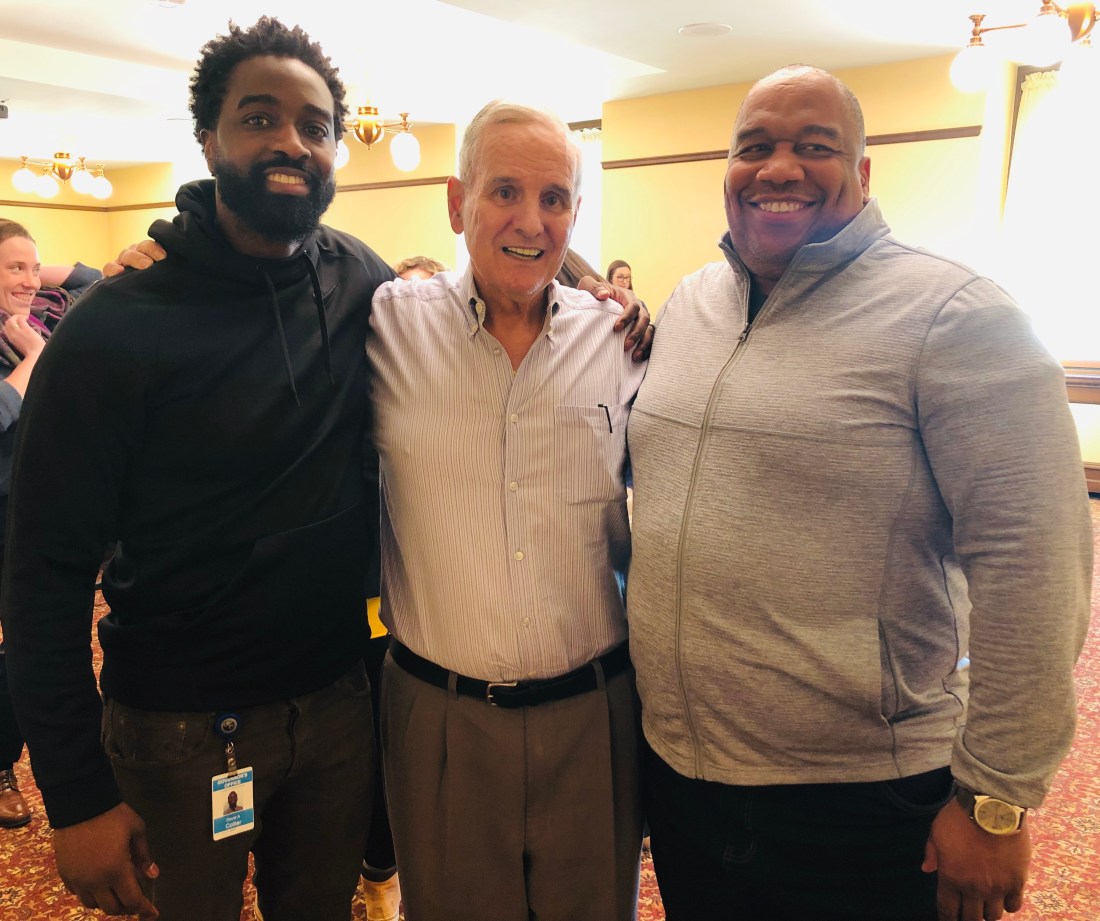
On January 7, 2019, in the Office of Inclusion for the State of Minnesota a new team will have “Next.” The Dayton administration team of James Burroughs, Chief Inclusion Officer, and David Collier, Senior Aide to the Chief Inclusion Officer, had a nice 2 1/2 year run in the Minnesota Inclusion Arena. This team of two Black Men who were strangers to each other came together through a mutual connection and without knowing whether they could play together and be successful as a team they decided to play together. During our games of Inclusion, Equity and Diversity, we have encountered intense fouls and competition. We have had back screens like the murder of Philando Castile set against us that knocked us to our knees. We have had sharp elbows and intense trash talking from the community saying that you do not represent your people and you are just a representative of “The Man.” We have at times been pushed into the corner and the ball has been kept from us so we could not focus on shooting, but instead just pick up rebounds and set some picks. Two Black men leading at the point guard and shooting guard at times scared away some members or our Minnesota Nice team, but in spite of these challenges we persevered and kept hooping.

While on our run, we made some great shots along the way. We stepped back to the three point line and raised our diverse employee percentage from 8% to 13.1%. Nice shot. We then went to our crossover move and took our employee with disability percentage from 4% to 7.1%. Nice move. We also took a page from Magic and went for our baby skyhook and took our diverse employee business percentage from 5.4% to 7.8%. While shooting the baby skyhook we also got fouled and had to take a free throw that helped increase our black owned business percentage spend from $135,000 to $2.4 million. We still are not shooting a great percentage at the line because these numbers are against a $2 billion spend, but we are getting better. Good shot. As we continued to play and get our rhythm we noticed the crowds looking at our moves and even cheering us on at times. Some people watching were the NAACP, AALF, Latino Lead. CAALS, MABL, People of Color Career Fair, Minority Chambers of Commerce, St. Paul and Minneapolis Chambers of Commerce and other community members that would cheer, but also hold us accountable when we threw the ball away or missed a big shot. The nature of fan accountability.

On January 7, 2019 at 12:00 pm our run will be over. We will have to high five each other and turn over the court to the Walz and Flanagan administration. They have “Next.” The next Chief Inclusion Officer and his/her aide will have to take it to the next level. It will be their turn to take the shots, drive the ball and score at the goal. They will also have to rebound the ball, play defense and show the area that they are in the game and playing to WIN! Just as the captain of a team in street/outdoor ball has to pick their team carefully, we hope the Walz/Flanagan team will do the same. Make sure the next team has “Game.” They will have 4 years on the court to beat our numbers so I am confident they will give us a run for the money. As David and I take our ball and towel and go home, we will reminisce about the victories, the defeats and what we learned along the way. We will cherish the new friends who challenged us to be better. We will also have respect for the opponents that fought hard against us because they made us better players. We are now teammates for life. Although we did not make the street/outdoor ball hall of fame, we did show some young people along the way that all Minnesotans can play in this game and do well.

Game Over!

JB

#FadetoBlack #BetterMN

Code Switching vs. Soul Switching

Code Switching vs. Soul Switching

The act of changing your language, tone and mannerisms in the way you express yourself in conversations or relationships is known as code switching. Code switching is often used by leaders of color to “fit in” in order to make others feel comfortable and not be viewed as intimidating or aggressive. Code switching is a way to have your voice heard and is sometimes necessary to make change.

The act of changing your values, convictions and beliefs and forsaking your history and heritage in the way you express yourself in relationships and the way you live your life is soul switching. Soul Switching is a fine line leaders of color must walk. When you lose yourself and your soul in order to have your voice heard and make change you may at the same time do more damage to yourself, your community and your sprit.

Follow the Soul of your convictions and shine as a leader. You may not always agree with others, but make sure you can make change and at the end of the day come home to your community. You have succeeded when your elders and youth from heaven and earth say job well done my good and faithful servant.

JB

#FadetoBlack